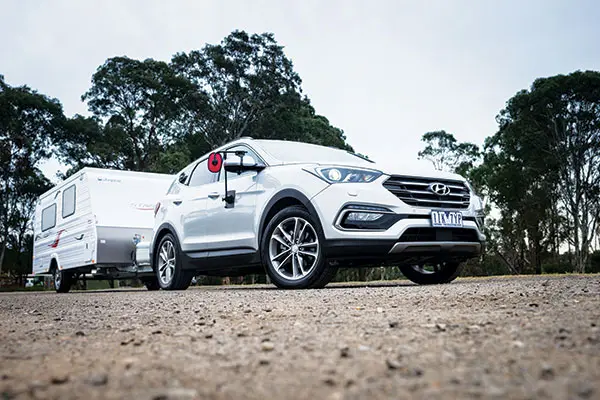
Hyundai Santa Fe Highlander Tow Test
Fairly modern SUVs like the Hyundai Santa Fe ride better, handle better and sip less fuel than dual-range, offroad-capable SUVs like the Ford Everest. Yes, vehicles such as the Everest have higher towing capacity and are better offroad, but what if you don’t tow a big van or go offroad? With its 2000kg/150kg towing maximums, the Santa Fe can tow many new single-axle vans, some new European tandem vans and plenty of older tandem vans (usually those without a shower toilet). So is the Santa Fe a realistic medium-sized tow tug? That’s what we aim to find out.
Interior
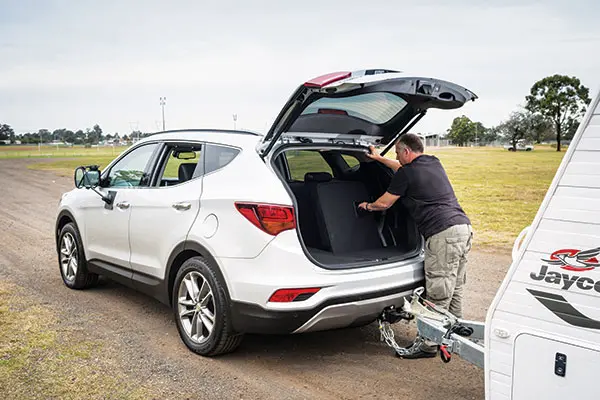
The Santa Fe’s cabin is comfortable and spacious, and is a testament to how far the brand has come – material quality and fit and finish are very good. It’s interesting to compare it with the similarly-priced Discovery Sport we tested last month – the Land Rover has a more luxurious presentation, but its standard equipment is relatively sparse. Once you opt for the Disco Sport up to the same level as the Hyundai, it is much more expensive. Only the Santa Fe’s third row seating is tight on room, and the small side windows back there don’t give occupants much of a view out. The cargo area space has a 560L capacity with third-row seats folded (1616L with both second- and third-row seats down). It has enough room to pile in holiday gear and is easy to access with a relatively low loading lip.

The Santa Fe’s 2.2L turbodiesel has been around since 2010, and while it delivers ample power and torque, it isn’t as smooth and quiet as more recent diesels. Yet it revs willingly to its redline, and the turbo lag at low rpm is minimal. Its mid-range response is excellent.
Where the 2.2L diesel also excels is in its fuel-sipping ways. With mostly highway cruising and a bit of urban running around thrown in, the Santa Fe averaged 7.2L/100km. With a 1168kg caravan hitched up, and including a mix of freeway and stop-start driving for photography, diesel consumption rose to 13L/100km.
The Santa Fe has standard, economy and sport modes, but for most driving (including towing), it works well in standard mode. The six-speed auto has a well-matched spread of ratios and is smooth with its gear changes, too. You’re not getting the most agile or dynamic SUV there is with the Santa Fe, but the local suspension tuning (which Hyundai does with all its vehicles sold here) has paid off. The ride is firm but supple enough, and it remains well-controlled over some of the typical rough roads we have in Oz. The new electronic driver assistance bundle works seamlessly. The active cruise control, for example, doesn’t leave braking until the last second (as some other ACC-equipped vehicles do) if traffic slows – it’s nice and progressive.
Towing Test
There are a few towing recommendations when you delve into the Santa Fe’s owner’s manual: Hyundai recommends that you don’t tow for the first 2000km of the vehicle’s life to allow everything to bed in and that you shouldn’t go faster than 100km/h (or 70km/h up steep hills). Hyundai also advises against using a weight distribution hitch (WDH). Provided that your van is well balanced and has a relatively low ball load, a WDH should be unnecessary anyway. The standard towball download is restricted to 100kg unless the Hyundai Genuine Load Assist Kit is fitted, which then increases the TBM maximum to 150kg. Still not ideal if you want to run 10 per cent at the maximum allowed towing weight, but much better than the five per cent without the kit.
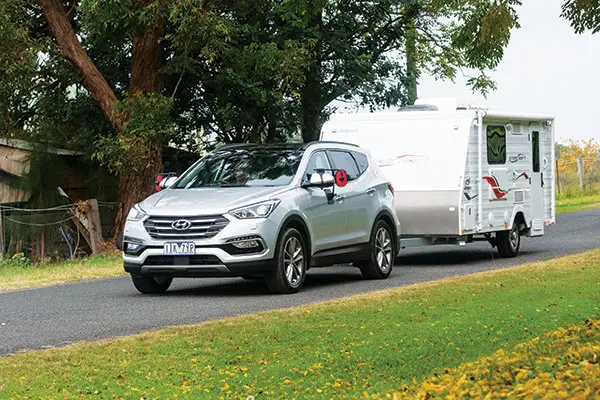
The van we towed weighed 1168kg and had 102kg on the towball, so it was pretty light. The only other choice available was close to 2000kg Tare, but that would not have allowed for theoretical payload and, thus, would not be representative of what the Santa Fe can tow.
The Jayco was a full-size van, though, and its Tare weight wasn’t exactly that of a box trailer. Backing up to the caravan coupling was easy with the Santa Fe’s rear-view camera, which gave a good, wide-angle vision, including the towball. Our towing mirrors (which attach to the Santa Fe’s mirrors) clipped onto the Hyundai’s mirror shells easily and were secure for the duration of the test. The rear of the Santa Fe barely dipped with the weight of the van dropped on its towball, no great surprise given the light ball load.
On the move, the Santa Fe towed the van well, with quite strong hill-climbing and overtaking ability. The Santa Fe was also very stable, with no swaying and very little pitching. Engine braking is quite poor; the Santa Fe’s relatively low-compression (for a diesel) and free-revving nature work against it when you need engine braking.
The Bottom Line
The Santa Fe Series II is still a competitive player in the medium-capacity SUV tow-vehicle market, with its new features and driver-assist technology keeping it fresh. Its towing performance is very good, with good fuel economy and touring range it. The only thing that could really improve the Santa Fe is how much it can tow: another 500kg in towing capacity would broaden the options considerably.
Thanks to Jayco Sydney for the loan of the caravan for this test.
Weights and Measures
Length: 4690mm
Width: 1880mm
Height: 1680mm
Wheelbase: 2700mm
Ground clearance: 185mm
Kerb mass: 1831kg
Gross Vehicle mass: 2600kg
Gross combined mass: 4600kg
Towing capacity unbraked/braked: 750kg/2000kg
Towball (max): 150kg
Price as tested: $60,283 (plus on-road costs)
Are You Still Shopping for the Perfect Camper or Van?
Daydreaming of buying a van this season? Check out our current selection of caravans for sale at OnlyVans.com.au!
We have a variety of used caravans and caravans from private sellers. You can also find motorhomes for sale and pop-top caravans. No matter how you like to travel, we've got you covered.
This article was written by Philip Lord, with photos by Matt Fehlberg and previously appeared at TradeRVs.com.au, now powered by OnlyVans.com.au.
Finding the perfect van is just the beginning. Getting caravan finance arranged so you can actually hit the road is where Credit One comes in. As Australia's best-reviewed finance broker with 3,000+ happy customers sharing five-star Google reviews, they know how to make it straightforward. Read through Credit One reviews from fellow adventurers, then try the loan repayment calculator to understand what fits your plans.